

AI Boom Fuels $120 Billion Tech Debt Surge in 2025: Alphabet, Meta, and Amazon Lead the Charge
By Ndefo Onyekachukwu | November 25, 2025
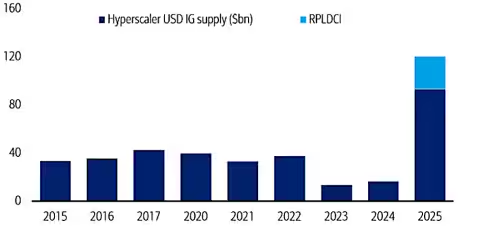
The artificial intelligence revolution is rewriting not just code, but corporate balance sheets. In 2025, Big Tech has issued nearly $120 billion in debt to fund the explosive growth of AI infrastructure – a 300%+ jump from typical annual loads, with hyperscale’s like Alphabet, Meta, Amazon, and Oracle alone borrowing over $90 billion in the last two months.
This borrowing frenzy – dubbed the “AI debt wave” – is powering data centers and chip fabs, but it’s raising red flags about over-leverage, with experts warning of bubble risks if returns don’t materialize.
From Meta’s $30 billion off-balance-sheet vehicle for Louisiana data centers to Oracle’s $18 billion junk bond sale, the scale is unprecedented. As Goldman Sachs notes, this debt could swell to $1.5 trillion by 2028, potentially widening credit spreads and risking market-wide fallout if AI hype cools. For African fintech watching closely, it’s a lesson in leveraging debt for growth amid funding droughts.
The Debt Wave: Scale and Drivers
Big Tech’s borrowing has hit records, with AI capex projected at $400 billion in 2025 – double last year’s $125 billion.
Key players:
Key players:
- Alphabet (Google): Filed for $17.5B U.S. + €6.5B (~$7.5B) Europe debt in November for AI/general purposes.
- Meta: $30B debt via special purpose vehicle (SPV) for Louisiana data center – off-balance-sheet to maintain healthy ratios.
- Amazon: $15B U.S. dollar bond in November – first in 3 years, $80B demand.
- Oracle: $18B debt in September for AI infrastructure.
- Microsoft: $19.4B deal with Nebius for computing power.
This $120B surge (up 300% YoY) funds data centers consuming power for millions of homes, but smaller players like Core Weave ($2B junk bonds) are borrowing aggressively too.
JPMorgan estimates hyperscale’s’ 2026 capex at $570B – up from $125B in 2021.
Bubble Risks: Is the AI Debt Frenzy Sustainable?
Goldman Sachs warns the debt could reach $1.5T by 2028, potentially widening spreads and stressing credit markets.
Concerns:
Concerns:
- Off-Balance Sheet Tricks: SPVs hide debt, making firms look healthier (e.g., Meta’s $30B vehicle).
- Smaller Players’ Risks: Startups like TeraWulf ($3.2B junk bonds) face defaults if AI returns lag.
- Credit Distress: CDS spreads on Oracle up; 95% of gen AI projects yield zero ROI per MIT.
- Historical Echoes: Like dot-com fiber overbuild, AI capex ($4T by 2030 per UBS) risks bust if adoption slows.
Optimists point to profitability: Nvidia’s $5T market cap and OpenAI 800M weekly users signal real demand.
Implications for African Fintech and Investors
For Nigeria’s fintech (e.g., PalmPay, Moniepoint), this is a lesson: Debt can fuel expansion, but local-currency borrowing (like Safaricom’s MTNs) hedges FX risks.
With Africa’s tech funding down 50%, strategic debt could bridge gaps. Investors: Monitor CDS spreads and ROI metrics – the boom is real, but leverage risks loom. What’s your take – AI debt bubble or smart bet? Comment below!
Sources:
- New York Times: Debt Has Entered the A.I. Boom (Nov 8, 2025)
- New York Times: Debt Funding Risks in AI Boom (Nov 10, 2025)
- Reuters: Tech Companies Tap Debt Markets for AI (Nov 24, 2025)
- Reuters: Five Debt Hotspots in AI Data Center Boom (Nov 5, 2025)
- Fortune: Tech Company Debt Macro Risks (Nov 20, 2025)
- Business Insider: Tech Debt Binge in AI Boom (Nov 18, 2025)
- NPR: AI Bubble Concerns (Nov 23, 2025)
- Economic Times: Data Center Debt Skyrockets (Nov 10, 2025)
- Silicon Valley: Big Tech’s AI Debt Wave (Nov 24, 2025)
- The Guardian: Boom or Bubble? $3tn AI Datacentre Spending (Nov 17, 2025)