


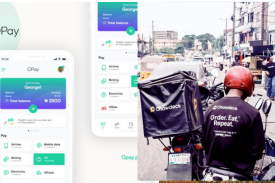
Chowdeck vs. OPay: The Frequency Flywheel Battle for Nigeria’s Super-App Future
FintechTodayNews.com Deep Dive – November 2025
In Nigeria’s hyper-competitive digital economy—where super-apps dominate consumer habits—Chowdeck and OPay represent two contrasting but converging paths to market leadership.
OPay, the long-established fintech powerhouse, has perfected the art of aggressive diversification. Chowdeck, the fast-rising delivery disruptor, is now turning its logistics moat into a fintech springboard.
Both companies are betting on the “frequency flywheel”: using daily, high-frequency consumer habits to layer profitable financial services. Yet their approaches differ in origin, execution, and risk.
Core Strategies: From Logistics to Ledgers
OPay’s Blitzscaling Blueprint
Since its 2018 launch as Opera’s African fintech arm, OPay has pursued a fintech-first super-app model—anchored on payments, wallets, and POS infrastructure.
- Backed by $570M+ in funding (including SoftBank’s $400M in 2021)
- Subsidized entry into multiple verticals: ORide, OFood, OExpress
- Now processes 100M+ daily transactions, supported by Huawei Cloud
- Captures 22% of Nigeria’s e-wallet market
- Has 300,000+ agents nationwide
- Expanded across Nigeria, Egypt, and Pakistan
Today, OPay’s focus is “invisible-layer dominance”—becoming the default payment rail for consumers and merchants while earning from transfers, loans, and remittances.
Chowdeck’s Frequency-First Fintech Leap
Chowdeck, founded in 2021, reversed the typical super-app playbook. It first built a high-frequency logistics engine, achieving:
- 10M+ deliveries
- 1.5M users across 11 Nigerian cities
- 1M monthly orders by March 2025
After raising $9M Series A in August 2025, Chowdeck launched:
- Bills Tab (airtime & data top-ups)
- Mira POS integration for merchants
This creates a closed-loop ecosystem where customers pay bills mid-order and merchants settle payments through Chowdeck’s unified rails. With a Ghana beta, the company is positioning itself for pan-African expansion.
FintechTodayNews.com Comparison Table: At a Glance
| Aspect | OPay Strategy | Chowdeck Strategy |
|---|---|---|
| Core Origin | Fintech-first (payments, wallets) | Logistics-first (food & grocery delivery) |
| User Acquisition | Subsidized multi-vertical blitzscaling | High-frequency 30-minute deliveries |
| Fintech Entry | Native (since 2018) | Layered (2025 Bills + Mira integration) |
| Monetization | Fees, loans, remittances, agents | Delivery commissions + emerging payments |
| Expansion | 3 countries, 50M+ users | 11 Nigerian cities, Ghana beta, 1.5M users |
| Funding | $570M+ (valued at $2.75B) | $12M total (Series A: $9M) |
| Key Enabler | AI fraud detection, agent networks | Unified POS & delivery rails |
Similarities: The Super-App Gospel
Both companies follow Reid Hoffman’s blitzscaling principles—trading efficiency for speed in uncertain markets.
They also exploit Nigeria’s 40% unbanked population by embedding financial services into daily routines:
- OPay → zero-fee transfers + POS ubiquity
- Chowdeck → bill-pay during delivery flow
Each has built a closed-loop ecosystem designed to retain users and circulate value:
- OPay loops funds through its agent & merchant network
- Chowdeck funnels order payments into merchant settlements
External shocks—such as the 2023 cash crunch—further accelerated digital adoption. OPay absorbed millions fleeing failing banks; Chowdeck capitalized on rising demand for urban convenience.
Differences: Proven Scale vs. Nimble Niche
Why OPay Leads
- A decade of pivots and regulatory recovery
- $2.75B valuation
- Strong Chinese capital backing
- 50M+ users and national POS distribution
- Regulatory experience (e.g., 2024 CBN onboarding halt)
Why Chowdeck Is a Disruptive Threat
- Delivery-first approach builds habitual engagement
- Fast-growing merchant rails via Mira
- Better positioned in the urban convenience economy
- Could unlock “food-as-a-fintech-gateway” at scale
- Targeting 5,000 daily orders by late 2025
Chowdeck’s niche agility may allow it to outmaneuver OPay in customer frequency—even if OPay maintains structural dominance.
FintechTodayNews.com Forward Look
Nigeria’s super-app future may require a blend of:
- OPay’s rail infrastructure
- Chowdeck’s habit-driven engagement
With Nigeria’s delivery market projected to grow from $14B today to $30B by 2030, the battleground is wide open.
Social chatter already imagines cross-platform synergy:
“Imagine sending money from OPay to Chowdeck to pay bills—super-app combo unlocked.”
Such interoperability—if it emerges—could reshape Nigeria’s digital economy.
FAQ: Chowdeck vs. OPay Strategies
1. What’s their biggest similarity?
Both rely on high-frequency behaviors to embed fintech into daily life.
2. How do their origins differ?
OPay began as a payments giant; Chowdeck began as a delivery engine and is now adding fintech.
3. What risks does Chowdeck face emulating OPay?
Regulatory scrutiny (KYC/AML) and OPay’s massive agent network could slow its fintech penetration.
4. Which has stronger scale today?
OPay dominates with 50M+ users and a multibillion-dollar valuation.
Chowdeck leads in delivery speed and customer frequency.
5. Could collaboration happen?
Yes—users already speculate about OPay → Chowdeck transfers for bill payments.
6. Who wins the super-app race?
OPay holds the structural advantage, but Chowdeck’s logistics-driven frequency could be the disruption OPay never saw coming.
For more insights on Africa’s fintech evolution…
Subscribe to FintechTodayNews.com — where strategies meet the street.



2 Comments
Pingback: How OPay Scaled to 10M+ Daily Users: The Ultimate 2025 Nigerian Fintech Case Study - FintechTodayNews
Pingback: Chowdeck Hits Nearly $1 Million In Black Friday Food Delivery Sales - FintechTodayNews