


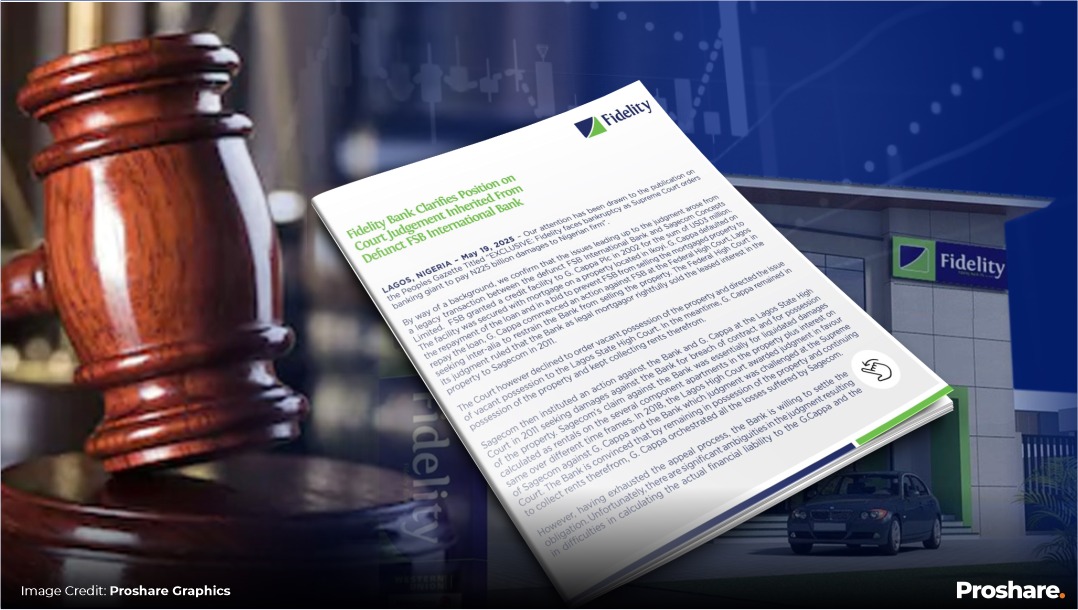
Supreme Court Rules in Favour of Fidelity Bank, Brings Closure to Two-Decade Sagecom Legal Dispute
Nigeria’s Supreme Court has delivered a landmark judgment in favour of Fidelity Bank Plc, bringing to an end a prolonged legal dispute spanning more than 20 years involving Sagecom Concept Limited. The ruling marks a significant legal victory for the bank and provides long-awaited clarity on a case that has lingered through multiple layers of Nigeria’s judicial system.
The decision is widely seen as a defining moment for corporate litigation in Nigeria’s banking sector, reinforcing the finality of Supreme Court judgments and the importance of due process in resolving long-running commercial disputes.
Background of the Sagecom–Fidelity Bank Dispute
The legal battle between Fidelity Bank and Sagecom dates back to the early 2000s, arising from a commercial transaction that later became the subject of litigation. Over the years, the dispute moved through various courts, including the Federal High Court and the Court of Appeal, before reaching the Supreme Court for final determination.
Like many complex commercial cases in Nigeria, the matter involved conflicting claims, contractual interpretations, and prolonged legal arguments, contributing to its unusually long lifespan.
Industry observers note that the case became one of the most closely watched banking-related disputes due to:
- Its long duration
- The financial and reputational implications involved
- The legal precedents it could establish
Supreme Court’s Final Ruling
In its judgment, the Supreme Court ruled in favour of Fidelity Bank, effectively dismissing the claims brought by Sagecom Concept Limited. The apex court’s decision puts a definitive end to all pending legal challenges connected to the dispute.
By upholding Fidelity Bank’s position, the court reaffirmed the principle that commercial disputes must be resolved based on evidence, contractual obligations, and established legal standards, rather than prolonged litigation tactics.
Legal experts say the ruling underscores the authority of the Supreme Court as the final arbiter in Nigeria’s judicial system, leaving no room for further appeal.
Why the Judgment Matters
The closure of the Sagecom case is significant for several reasons:
1. Legal Certainty for Businesses
The ruling provides reassurance to businesses operating in Nigeria that even long-running disputes can ultimately be resolved through the judicial process. It reinforces confidence in the legal system’s ability to bring finality to complex cases.
2. Banking Sector Stability
For the banking industry, the judgment removes a lingering legal uncertainty surrounding Fidelity Bank. Analysts note that unresolved litigation can affect investor perception, regulatory relationships, and corporate planning.
3. Judicial Efficiency Debate
While the case highlights the need for faster dispute resolution mechanisms, its conclusion demonstrates that Nigeria’s legal system can still deliver decisive outcomes, even if delayed.
Fidelity Bank’s Position
Fidelity Bank has consistently maintained that its actions in the disputed transaction were lawful and in line with existing agreements. The Supreme Court’s ruling effectively validates the bank’s position after years of legal scrutiny.
Market watchers say the judgment strengthens Fidelity Bank’s corporate governance image and may have a positive impact on:
- Investor confidence
- Brand reputation
- Long-term strategic planning
Although the bank has not released extensive public commentary, the ruling itself is widely regarded as a reputational boost.
Impact on Sagecom Concept Limited
For Sagecom, the judgment marks the end of legal avenues available in the dispute. With the Supreme Court’s ruling, all outstanding claims related to the matter are considered settled.
Legal analysts note that while prolonged litigation can be costly and disruptive, final judgments—regardless of outcome—provide clarity that allows parties to move forward.
Broader Implications for Commercial Litigation in Nigeria
The Fidelity Bank–Sagecom case adds to ongoing discussions about commercial dispute resolution in Nigeria. Key takeaways include:
- The importance of clear contracts: Well-drafted agreements can reduce ambiguity and limit litigation risks.
- Need for alternative dispute resolution (ADR): Arbitration and mediation could help prevent cases from dragging on for decades.
- Judicial reforms: Calls continue for reforms to speed up commercial case handling without compromising fairness.
The ruling may encourage businesses to pursue settlements or ADR mechanisms earlier, rather than relying solely on extended court battles.
Investor and Market Reactions
While the immediate financial impact of the ruling may be limited, market analysts say the decision sends a positive signal to investors. Legal certainty is a critical factor in investment decisions, particularly in regulated sectors like banking and finance.
By removing a long-standing legal overhang, Fidelity Bank is better positioned to focus on:
- Core banking operations
- Digital transformation initiatives
- Expansion and innovation strategies
Lessons for the Banking and Corporate Sector
The case offers several lessons for corporate Nigeria:
- Prolonged litigation can drain resources and management focus
- Strong legal documentation is critical in commercial transactions
- Judicial finality, though sometimes slow, remains a cornerstone of the business environment
Experts also point out that businesses should balance legal rights with pragmatic dispute-resolution strategies to avoid decades-long legal uncertainty.
What Happens Next
With the Supreme Court’s ruling, the case is legally concluded. Attention now shifts to how both parties move forward post-judgment. For Fidelity Bank, the focus is likely to remain on strengthening its market position and operational growth.
For the wider business community, the judgment serves as a reminder of the value of patience, legal diligence, and adherence to contractual obligations.
Big Picture
The Supreme Court’s decision in favour of Fidelity Bank closes a significant chapter in Nigeria’s commercial litigation history. After more than two decades of legal battles, the ruling delivers finality, reinforces judicial authority, and restores certainty for all parties involved.
As Nigeria continues to position itself as an attractive destination for investment, outcomes like this—despite delays—highlight the enduring role of the judiciary in upholding the rule of law and protecting commercial interests.